An external wrapper that adds a judgment layer.
Public-level explanation only. LimFlex differs at the root: its principle, approach, and method add judgment capability itself, then connect that judgment to accountable responsibility, usable next steps, and audit evidence at runtime.
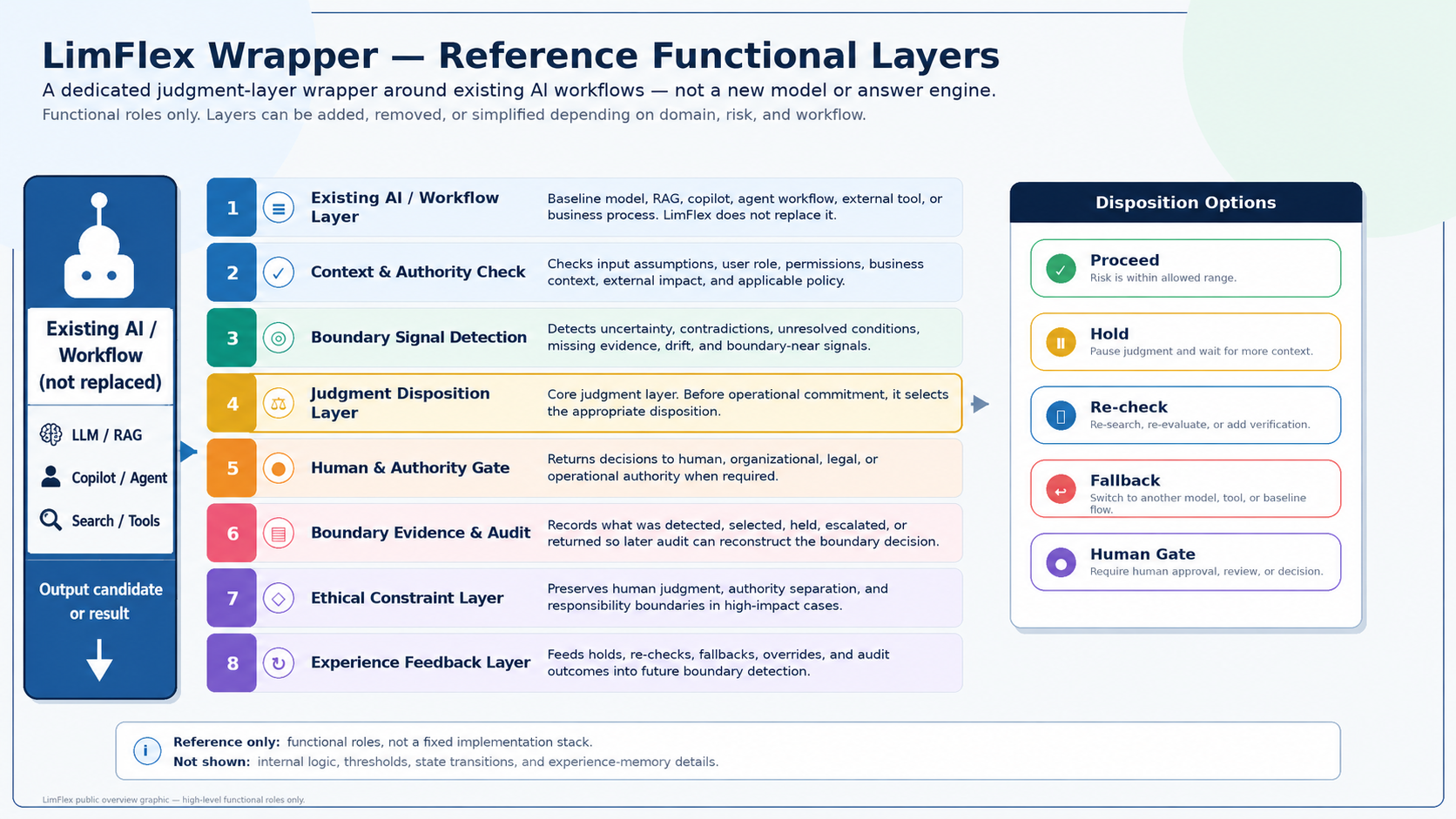
8-layer architecture
LimFlex is organized as a layered judgment function around existing AI-assisted workflows: from output observation to governed HOLD, bounded action, human responsibility, user guidance, audit evidence, and decision reconstruction.
- AI output observation
- Risk and uncertainty signals
- Proceed / HOLD / constrain / re-check selection
- Human review routing
- Audit evidence capture
- External wrapper separation
- Decision reconstruction
- Workflow integration
Public visuals
Visual explanation first; downloadable public PDFs are placed directly below.
Reference functional layers
8-layer public architecture image.
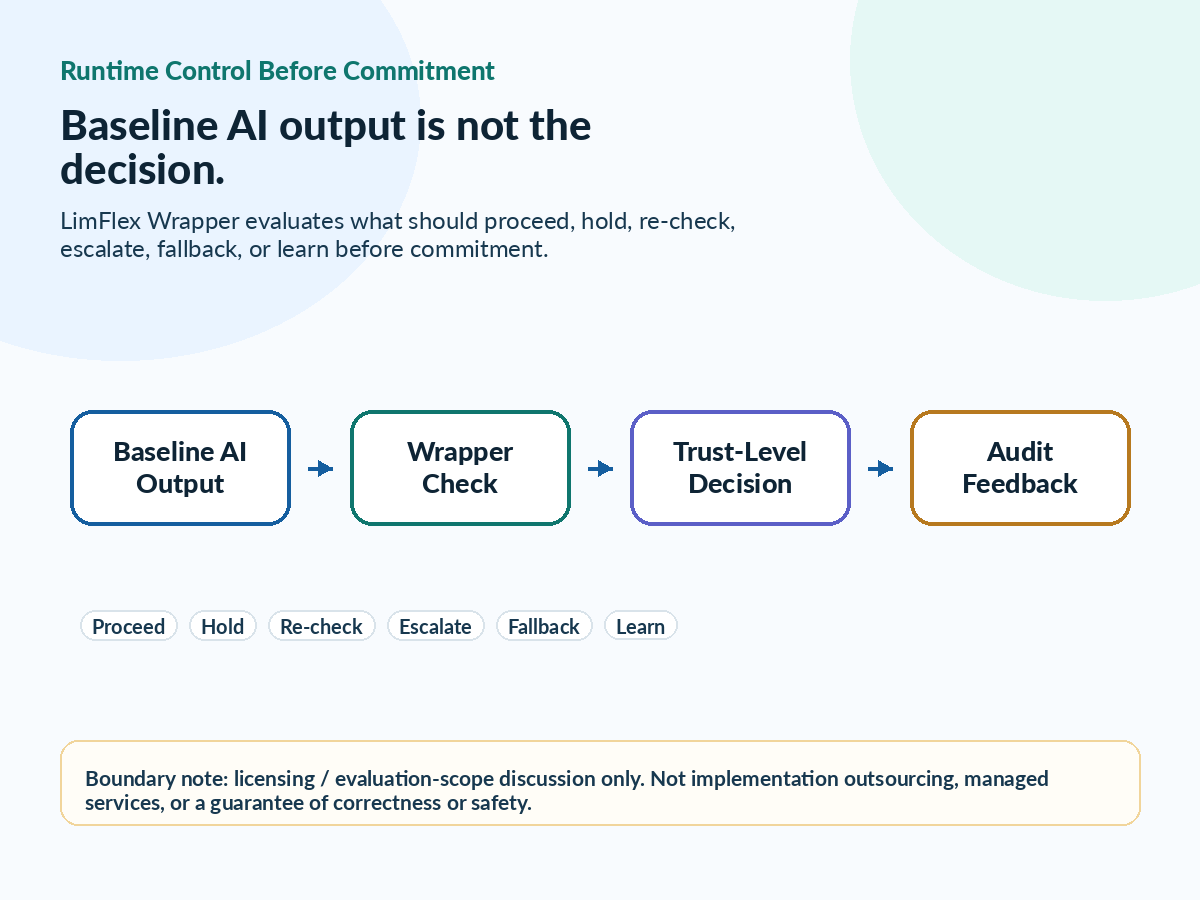
Runtime control flow
How wrapper checks sit before business commitment.
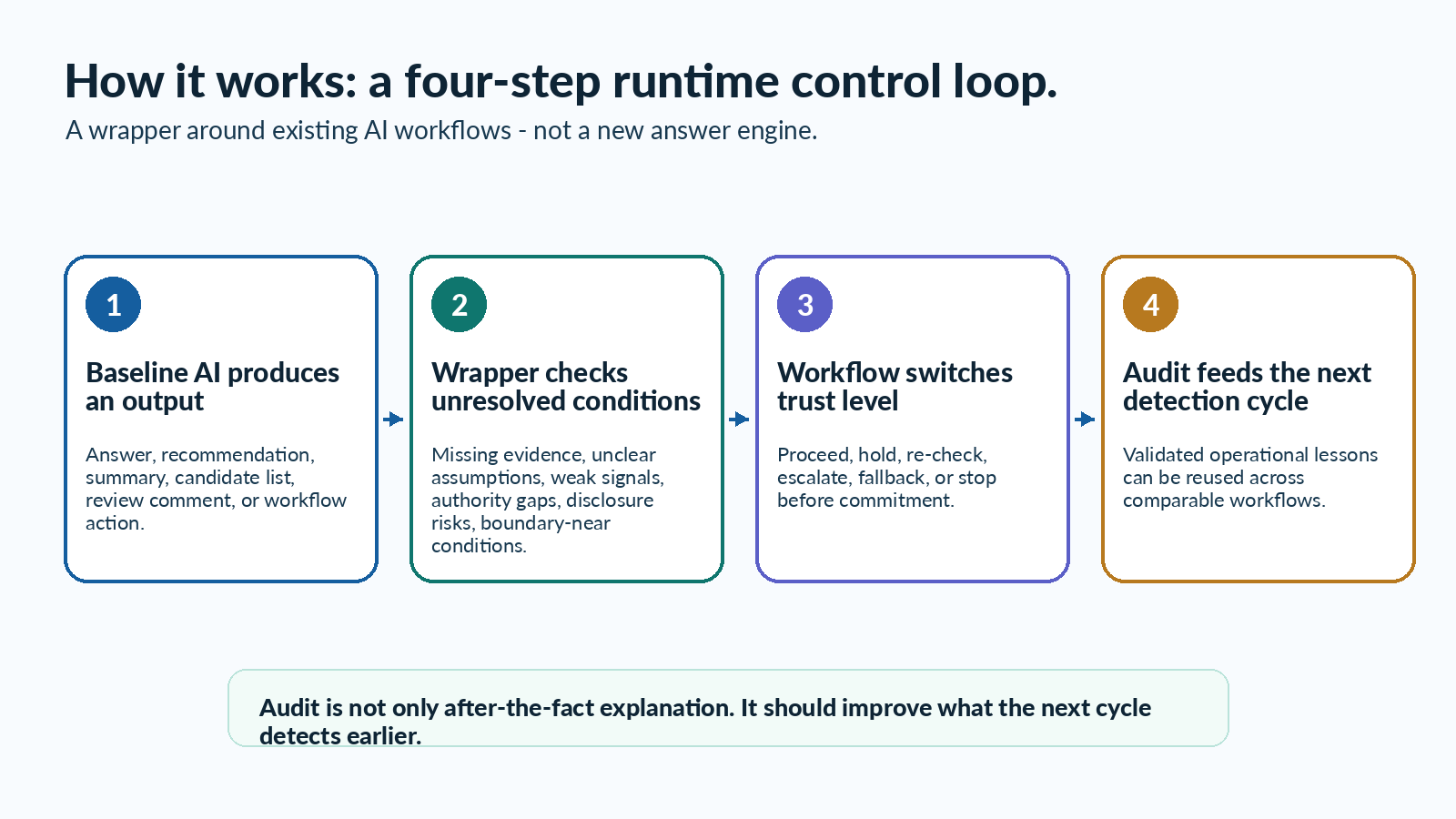
Four-step loop
Observe, hold or re-check, route, and learn from review feedback.
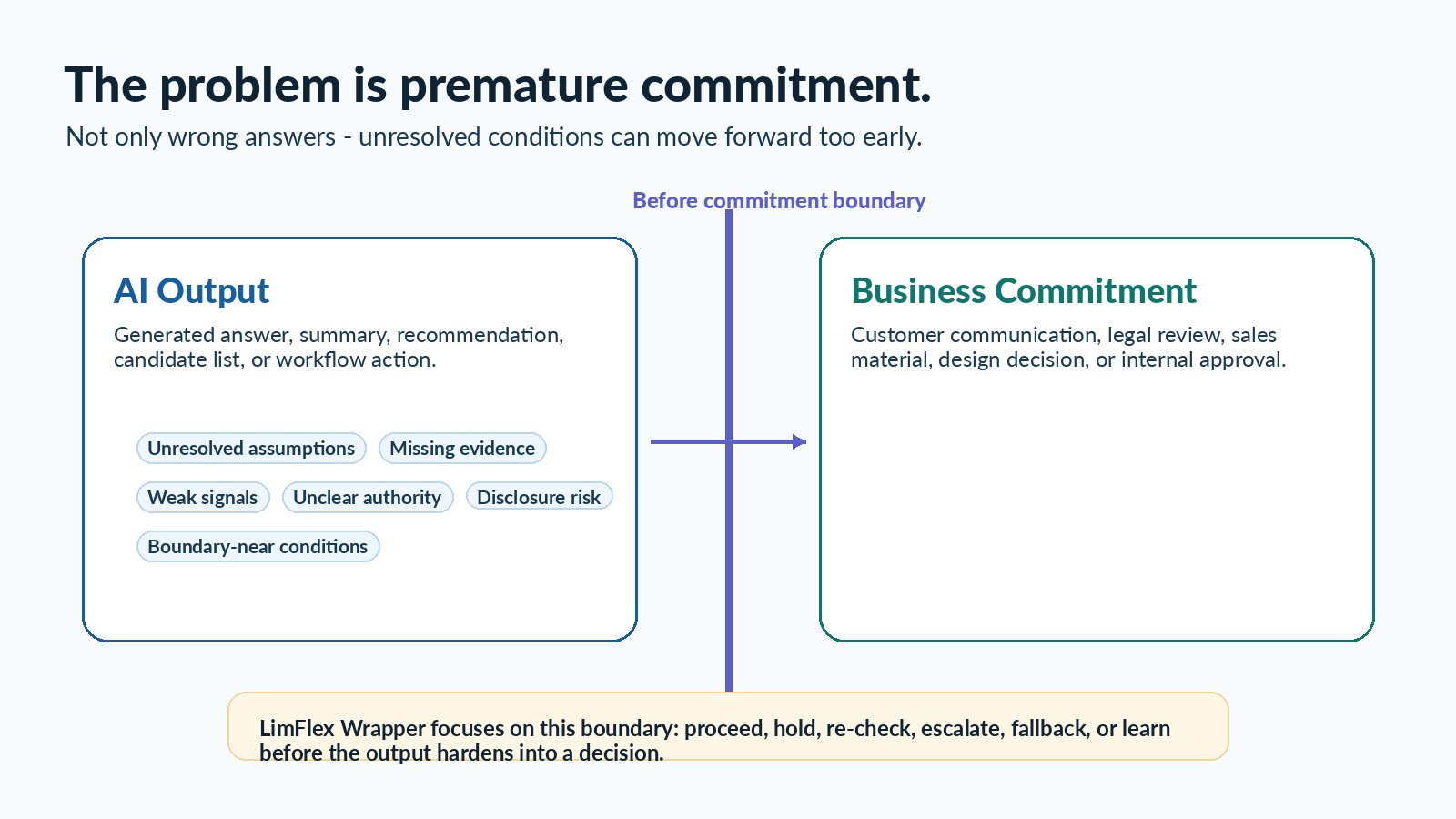
Before commitment boundary
Why the boundary must exist before action.
Related public overview pages
Earlier public explanations are integrated here as deeper public pages.
Candidate-loss risk
Looks at valuable cases that may be discarded before review can see their value.
Governed HOLD
Shows HOLD as a controllable state before commitment, with re-check and human-review paths.
What the wrapper adds
LimFlex adds a separate judgment layer around existing AI-assisted workflows. It operates judgment states before an AI-assisted output becomes an operational commitment: proceed, HOLD, constrain, re-check, advise, escalate, reconnect responsibility, or return to a safer baseline.
- Proceed under current conditions
- Preserve an unresolved judgment in governed HOLD
- Ask for additional verification or recommend the next bounded action
- Escalate to a higher review path
- Return to human review when responsibility must reconnect
Why the foundation is different
Most control technologies add selected governance functions around an existing AI system. LimFlex adds the judgment function itself. That makes it possible to connect evidence and boundaries to accountable responsibility, while also returning usable, bounded guidance instead of only allowing or stopping an action.
- Audit evidence
- Human-in-the-loop control
- External wrapper separation
- API and workflow fit
- Cost fit and proof points
Coordinating work is not the same as governing judgment.
Fixed flows pass work forward. Orchestration coordinates roles, branching, retries, and combined results. Dynamic teams can even change their own composition. The next structural step is different: an executable judgment layer must determine whether the system may proceed, HOLD, re-evaluate, return, escalate, or stop.
Controlled improvement of judgment criteria
Where configured, the judgment layer can interpret policies, standards, procedures, and operational evidence to propose or apply improvements to its judgment criteria. This is governed adaptation, not unrestricted self-modification.
- Source documents and operational evidence remain linked to the proposed change
- Changes are versioned and testable before broader use
- Rollback and return-to-baseline conditions are retained
- High-impact changes return to Human Gate where required